

April 8, 2026
Intercultural understanding is now a familiar goal in education and plays a core role in the globally respected Australian Curriculum as one of seven general capabilities. But how do teachers create culturally competent learning environments for their students?
Some existing frameworks offer powerful support for building intercultural understanding in theory. Cultural Infusion insists that to meet students’ real, practical needs for intercultural understanding, educators need precise baseline data that reveal the specific cultural attributes present in their own classrooms. Often invisible and unacknowledged, these attributes are a teacher’s most valuable resource for culturally responsive teaching. After all, how does a teacher create a sense of belonging when they don’t really know who’s in the room? What false assumptions about their students could they be bringing to class?
Cultural Infusion’s Atlas, supported by the Victorian Government’s Future Ready program, brings the missing information on who is in the room while maintaining anonymity and data privacy. This information is a resource that replaces assumptions with curiosity and respect, offering students and educators insight and capabilities that help them understand their identities in the context of the classroom and each other. This equips them with better skills to navigate our increasingly superdiverse, globalised and volatile societies – where 89% of all conflicts in the world occur in countries with low intercultural dialogue.
Existing Frameworks
UNESCO’s Intercultural Competences: Conceptual and Operational Framework presents intercultural competence as the ability to interact well across cultures through knowledge, skills, attitudes and mediation. Its strength lies in treating the educator as more than a transmitter of content: the teacher becomes an interpreting mediator, guiding students through difference with dialogue, storytelling and shared meaning-making. This is an essential vision, because it recognises classrooms as places where students bring different languages, histories, beliefs and experiences of belonging.
The OECD’s Global Competence Framework adds a practical policy dimension. It identifies four core capacities: examining local and global issues; understanding and appreciating different perspectives; engaging in open and respectful dialogue; and taking responsible action for sustainability and wellbeing. This translates into classroom strategy, where inquiry, reflection and dialogue are tools for building empathy, civic participation and shared responsibility.
As powerful as they are, both these frameworks leave a crucial question underdeveloped: how does a teacher know, with accuracy, which cultural realities are present in the room?
Cultural Infusion’s answer is precise baseline cultural data. Rather than relying on assumptions or generalisations, educators can identify the specific languages, heritages, and other identity markers that want acknowledgment in their classrooms. Cultural Infusion’s Atlas for Schools explicitly aims to measure, understand and enhance inclusion through interactive data, real-time insights, and reporting that bring a classroom or school’s diversity story into view.
Importantly, the Atlas adheres to the highest security and data privacy standards. The Atlas collects data via a short (approximately 4-minute) survey. All data gathered via the survey is on a voluntary basis, and all data are anonymised, de-identified and disaggregated with the option ‘prefer not to answer’ available for all sensitive questions. The resulting information forms a collective ‘snapshot’ of the class’s cultural composition: e.g. four Vietnamese grandparents (who could belong to one, two, three or four students), two students born in Hong Kong, one Greek speaker. To preserve anonymity across all the data, the Atlas requires groups of at least 20 people.
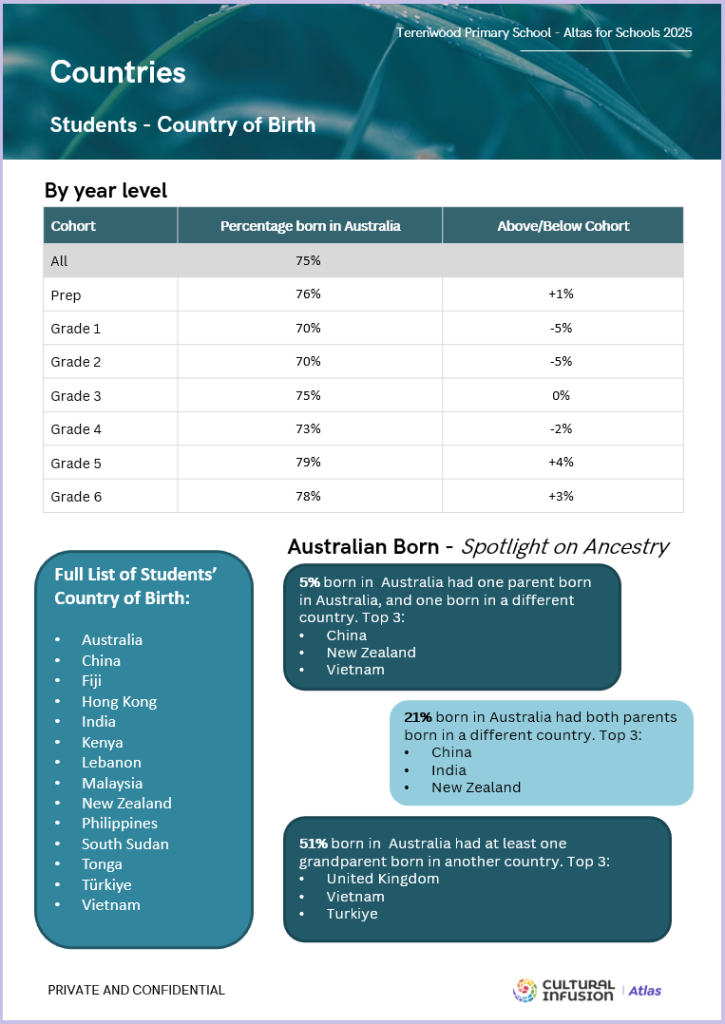
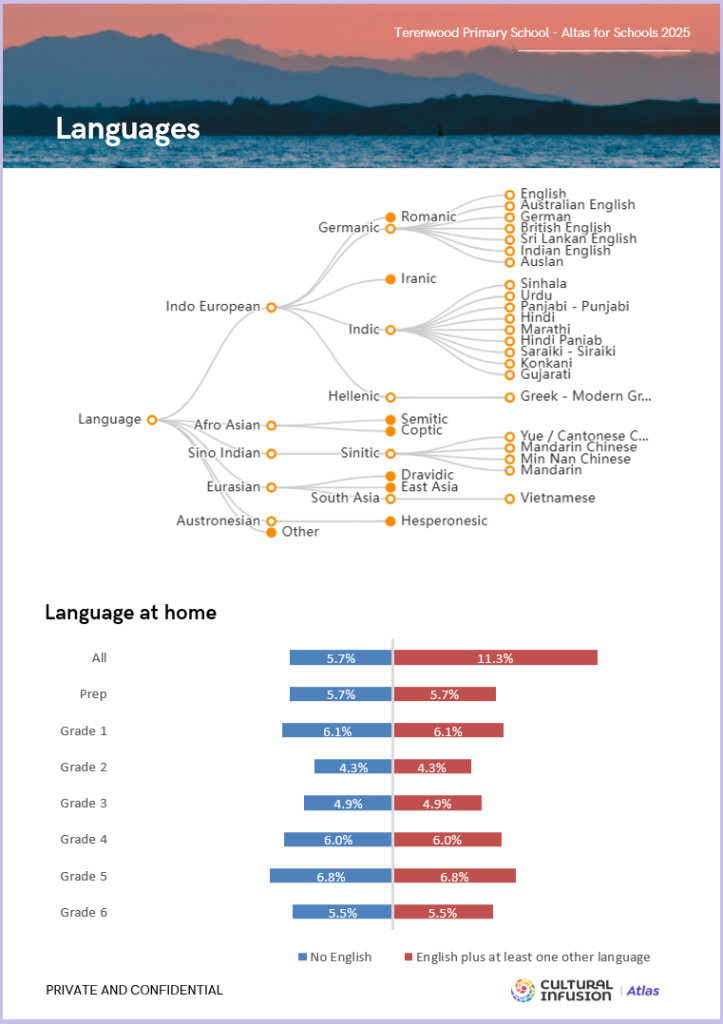
Cultural Infusion conceives of cultural identity as collective and temporal rather than individual and fixed. Therefore, our data represents collective rather than individual identities.
Cultural Humility
Tervalon and Murray-García describe cultural humility as a lifelong process of self-reflection, self-critique and attention to power imbalances, rather than a finite list of cultural facts to master.
Cultural humility aligns closely with Cultural Infusion’s approach because it resists the idea that a teacher can ‘know’ culture once and for all. Instead, it asks educators to keep learning with communities, adjusting practice as student identities, language needs and family contexts become clearer or change.
Specificity deepens belonging. Kathryn Riley’s work on compassionate leadership argues that belonging is not accidental; it is created through daily practices, visibility language, and care. When teachers know more precisely who their students are, they can design routines and learning experiences that make identity visible and valued. A classroom that recognises home languages, family traditions or migrant experiences is not simply ‘inclusive’ in name; it is actively shaping a culture in which students feel safe, respected and encouraged to contribute.
Sharpening the Focus
UNESCO reminds us that intercultural competence involves mediation. The OECD shows that global competence can be taught and enacted. Tervalon and Murray-García insist that humility must replace certainty. Riley demonstrates that belonging grows through compassionate leadership.
Cultural Infusion sharpens these ideas by insisting that inclusion begins with knowing the precise cultural attributes present in a classroom. With comprehensive baseline data, teachers can move from broad awareness to precise, student-centred practice.
Case Study: Toby’s Lived Experience in the Multicultural Classroom
Cultural Infusion’s Program Coordinator Toby Mills offers this case study of his experiences delivering our 8-week Intercultural Citizenship Ambassador Program (ICAP) at Epping Secondary College in Melbourne’s north.
Delivering Cultural Infusion’s ICAP program revealed to me the profound importance of creating safe intercultural classrooms.
Year 7 can be an especially challenging time for youth due to a range of factors from puberty and rapidly changing social circles. Students in this period of youth can therefore be significantly vulnerable to feelings of exclusion, low esteem and identity insecurities. This leads to the importance of creating safe classrooms that function to foster inclusivity and student wellbeing which will hence increase student engagement and academic performance.
Through the 8 sessions of ICAP, we discussed important topics surrounding the key themes of culture, identity, wellbeing and belonging. While most students appeared to have a general understanding of the topics discussed, many seemed to be new to discussing them in depth. At first this showed up as a lack of engagement, however over time, when they found resonance between themselves and the topics discussed like, ‘What cultural celebrations have you experienced?’ or ‘What is something kind you did for a peer recently?’, this showed significant increased engagement and joy. What I found was core to increasing the vital outcomes of belonging and increased wellbeing was for students to feel represented and valued.
Exploring the intersecting themes like identity, culture and values further highlighted the importance of functioning intercultural classrooms as a necessary foundation for student wellbeing and growth.
Genius Level: Overcoming Data Resistance
Toby’s experience at Epping Secondary College shows that intercultural classrooms are spaces where belonging, identity and wellbeing are actively shaped. When students are given opportunities to recognise themselves in the learning, engagement deepens and classroom relationships strengthen. This case study reinforces a central principle of Cultural Infusion’s work: inclusion is most effective when it is specific, intentional and grounded in the lived realities of students.
Teachers are often reluctant to collect student data because it can feel like extra bureaucracy, raise privacy concerns and fears of reducing students to metrics. Teachers can also feel that lack of the time, training and support to collect and use data well can make the task feel burdensome rather than helpful. Another issue is trust: teachers may worry that information will be misused, interpreted simplistically, or used to label children. Privacy and ethics are also a real concern, especially where schools collect sensitive information without clear communication about who can access it and how it will be used.
Cultural Infusion’s Atlas addresses these concerns with a strong confidentiality model, and by making data collection secure, purposeful and educationally useful by giving teachers ready-to-use lesson plans and resources so the data immediately supports classroom practice. Teachers are not left with raw data to interpret alone; they get usable outputs, reports and curriculum-ready activities.
The Atlas focuses on inclusion, representation and collective understanding rather than individual profiling. Its approach is to map patterns in cultural identity, language, heritage and related attributes so schools can better recognise who is in the room and respond with more precision, making it a state-of-the-art support for the work of care, visibility and inclusion.
To take intercultural competence in the classroom to genius level, educators must move beyond general commitments to diversity and towards the use of cultural data that can reveal what wants to be acknowledged in the room, the full range of identity attributes that matter to their students, and how teaching can respond with precision. Such data helps a teacher drop assumptions and become more curious about their students. An informed teacher can choose a range of examples and lessons that resonate more strongly with more students, and more easily recognise when a student’s participation may be shaped by language, identity or family context.
In using baseline diversity data, schools can build culturally competent learning environments where every student is appropriately recognised, engaged and valued.
Want to understand how Cultural Infusion defines culture, cultural identity and cultural diversity? Read our post here or our technical paper in the UNESCO Digital Library here.
About the author:
Share this Post